Switching from RankSpot sounds simple until you compare what you actually get. Two services can both promise AI visibility and still work nothing alike, and the gap shows up in your first month. Rankera publishes brand mentions across six channels each month around the searches your buyers make.
This article walks through seven mistakes to avoid when switching, from confusing done-for-you with self-serve to skipping a migration plan. By the end, you will know which questions to ask before you commit and whether Rankera fits your business type.
What Is Rankera? The Done-For-You AI Visibility Service
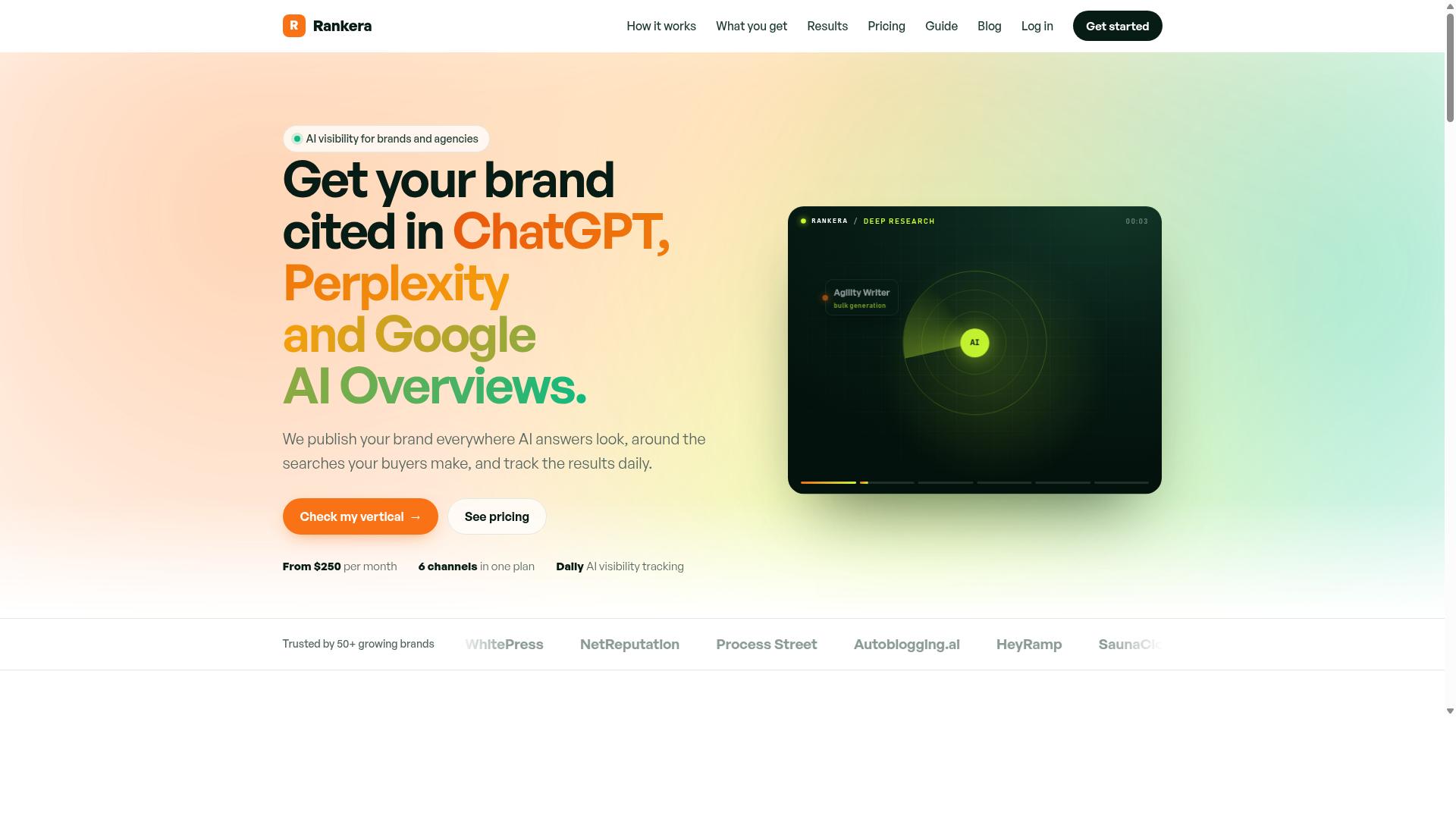
Rankera is a done-for-you service that gets your brand cited and recommended inside ChatGPT, Perplexity, and Google AI Overviews, rather than just tracked in a dashboard. That distinction matters because AI visibility is becoming the new front page of search.
As buyers shift from blue links to generated answers, ranking first no longer guarantees being recommended. AI answers usually name two or three brands and choose them based on what other sources say, not just what your own site claims.
Rankera publishes brand mentions across six channels each month, built around the searches real buyers make. There are no pitching requirements and no per-placement fees. Self-serve tools only monitor mentions, while Rankera handles the publishing side for you.
Who Rankera Serves and Where It Works
Rankera works with brands, SaaS companies, service businesses, and agencies that want white-label AI visibility, and it serves clients globally with English-language content. The service fits any business that sells online and wants to be named in AI answers, not just appear in a rankings table.
The client mix spans both local and digital operations. Common use cases include:
- Local businesses such as dental and medical clinics, law firms, roofing and HVAC contractors, real estate, and recovery or treatment centres
- Small businesses including online shops, consultants and coaches, B2B service firms, independent software makers, and one-person agencies
- Larger organisations in SaaS, ecommerce, healthcare, hospitality, and home services
- Agencies that want to resell AI visibility under their own brand, including SEO and content agencies, digital PR and reputation firms, web design studios, and consultancies
Businesses with several locations are a particularly strong fit, since each location competes for its own set of local searches. The publishing side runs in English across Google, Bing, YouTube, Medium, Instagram, and GitHub, so mentions land on platforms that AI systems already draw from when assembling answers.
Because the process is managed end to end, clients do not need an in-house content team or a separate outreach budget. That is the core of the done-for-you model: research, planning, publishing, and daily tracking of AI mentions and Google rankings happen as one continuous service.
Are Rankera and RankSpot the Same? Answering the Switching Question
No, Rankera and RankSpot are not the same, and conflating them is the first mistake people make when searching for a RankSpot alternative. They belong to different categories of tool, even though both touch on how a brand shows up in search.
RankSpot is typically a self-serve SEO software suite. Its core jobs are monitoring and analysis: a keyword rank tracker, SERP monitoring, backlink analysis, site audit checks, and competitor research. You log in, read the dashboards, and decide what to do next. The software reports; you execute.
Rankera sits on the other side of that line. It is a done-for-you AI visibility service, not a dashboard you operate yourself. The goal is different: getting your brand cited in AI answers, rather than watching traditional organic traffic metrics move.
That distinction matters because it changes what "switching" even means. RankSpot helps you monitor and analyze. Rankera gets you cited in AI answers. One is a measurement layer, the other is an execution layer.
Rankera's model covers six channels in one plan with daily AI visibility tracking. It publishes brand mentions on publications Rankera owns in your niche, with no pitching, no per-placement fee, and no backlinks. Business setup happens within 48 hours of subscribing.
The results it reports are visibility outcomes, not crawl diagnostics. On its own brand, Autoblogging.ai, AI Overview mentions rose from 48% in July to 70% by October 2026. Named-first mentions climbed from 7% to 46%, and top-three placements from 26% to 64%.
So before you treat one as a drop-in replacement for the other, ask what problem you are actually solving:
- Monitoring problem: you need rank tracking, backlink analysis, and site audit data. That is classic SEO software territory.
- Visibility problem: you need your brand showing up in AI-generated answers. That is the category Rankera operates in.
- Both: plenty of teams run a self-serve suite for diagnostics and a done-for-you service for AI visibility. They are complements, not substitutes.
Assuming a like-for-like swap is where the trouble starts. If you cancel RankSpot expecting Rankera to replace your rank tracker or your crawl reports, you will lose the monitoring you relied on and gain a service doing something else entirely.
The honest framing is this: Rankera is not a RankSpot alternative in the strict sense. It is a different kind of solution for a different kind of search visibility, and judging it against a self-serve SEO suite's feature list will always produce a misleading comparison.
Mistake 1: Assuming Every "Alternative" Works the Same Way
The biggest error when switching from RankSpot is assuming every alternative operates on the same self-serve, dashboard-driven model. It does not.
Tools marketed as RankSpot alternatives fall into two very different camps: self-serve software and done-for-you services. One hands you a login and expects you to do the work. The other does the work for you.
That single distinction shapes your workload, time-to-results, and cost structure more than any feature checklist. Confusing the two leads to mismatched expectations, wasted budget, and a switch that solves nothing.
Done-For-You vs. Self-Serve: Why the Model Matters More Than the Label
With self-serve tools like RankSpot, you get a login and a dashboard; with Rankera, you get a team that publishes brand mentions for you. That is not a minor packaging difference. It changes who does the labor.
A self-serve platform puts every task back on your desk. You run the site audit, chase indexing issues, clean up redirect chains, monitor SERP positions, and build links yourself. The software surfaces the problem, but you still supply the hours.
Done-for-you flips that equation. Rankera publishes across six channels on one shared keyword list:
- Brand mentions in niche publications, where your brand is named and recommended on publications Rankera owns in your niche, with no pitching and no per-placement fee
- Medium articles, using the same keywords from a different angle
- YouTube videos, one per keyword, titled like the search
- YouTube Shorts, a Short for every keyword
- Instagram Reels, every Short repurposed where buyers scroll
- GitHub Gists, structured pages tying the work together
Every new page is submitted to Google and Bing, and daily tracking covers AI Overview mentions and Google rankings. The practical effect is that the learning curve and the ongoing labor disappear. Consider a simple example: instead of you pitching a guest post, waiting weeks for a reply, and negotiating placement terms, Rankera publishes your brand mention on a niche publication it owns.
This is why the model matters more than the label. Two products can both call themselves an SEO alternative while demanding completely different levels of involvement. Before you compare features or pricing, decide whether you want to operate a tool or hand off the execution. Agencies face the same fork, and Rankera's white-label GEO option serves that path with unbranded PDF and CSV reports plus read-only share links.
One boundary is worth noting early. Rankera does not manage Google Business Profiles, reviews, categories, or posts, and does not edit client websites. If those tasks sit on your list, a done-for-you service will not absorb them, and assuming otherwise is its own switching mistake.
Mistake 2: Overlooking Which Channels You Actually Get
Many RankSpot users assume any alternative will cover the same channels they already use, but channel coverage varies wildly. That assumption is where the trouble starts.
RankSpot focuses on traditional SEO data such as SERPs, backlink analysis, and site audits. Those outputs are useful, but they live in one lane. AI visibility depends on your brand showing up across different surfaces entirely, including video, social, and publications that AI systems draw from when generating answers.
Switch without checking channel coverage, and you can lose visibility on platforms that actually matter to how buyers find you now. The next section breaks down exactly what Rankera includes.
Rankera's Six Channels on One Shared Keyword List
Rankera publishes your brand mentions across six channels, Google, Bing, YouTube, Medium, Instagram, and GitHub, all tied to one shared keyword list. Every plan includes all six. Nothing here is sold as a separate add-on.
The shared keyword list is what keeps everything consistent. The same target searches drive content across every channel, so your messaging stays aligned instead of fragmenting into disconnected campaigns.
Rankera also owns niche publications where your brand is named and recommended. That means no pitching and no per-placement fee. You are not chasing editors or paying for each mention. Coverage happens on publications Rankera controls in your niche.
Here is how the six channels work together:
- Niche publications: brand mentions where you are named and recommended, with no pitching and no per-placement fee
- Medium articles: same keywords, different angle
- YouTube videos: one per keyword, titled like the search
- YouTube Shorts: a Short for every keyword
- Instagram Reels: every Short, placed where buyers scroll
- GitHub Gists: structured pages tying it together
Every new page is submitted to Google and Bing, and Rankera tracks AI Overview mentions and Google rankings daily. This multi-channel spread is what gets brands cited in AI answers. AI systems pull from many sources, so a presence on one channel alone rarely earns that citation.
Mistake 3: Ignoring How AI Mentions Are Tracked
If you don't know how your AI mentions are tracked, you can't tell whether your new service is actually working. This is one of the most overlooked traps in any SEO software migration. Teams spend weeks comparing keyword rank trackers and SERP monitoring features, then never ask the single question that matters most in 2025: does this tool actually measure how AI answers talk about my brand?
Traditional platforms were built for a different era. They report where a page ranks for a query, how positions shift over time, and how competitors compare on organic traffic. That data still has value, but it says nothing about whether ChatGPT, Perplexity, or Google AI Overviews are naming your brand at all.
Rankera treats AI visibility as a first-class metric rather than an afterthought. Its tracking runs daily, covering both AI Overview mentions and Google rankings. That cadence matters because AI answers change quickly, and a weekly snapshot can hide shifts that affect how often your brand gets recommended.
The dashboard surfaces the signals that tell you whether the work is landing. Expect to see the number of citations your brand earns and the context in which those mentions appear. Context is the part most tools miss. Being listed in a comparison is not the same as being named as the top pick, and a citation count alone won't reveal that difference.
This is where RankSpot alternatives tend to fall short. RankSpot tracks traditional search rankings but does not track AI answers. If you switch to a similar tool, you inherit the same blind spot, and you lose the ability to connect publishing activity to AI recommendations.
Rankera's process closes that loop. It publishes brand mentions across six channels each month around the searches buyers actually make, then tracks AI mentions and rankings daily. The company's stated position is blunt: ranking first no longer means being recommended, because AI answers name two or three brands and choose them based on what other sources say.
Before you commit to any alternative, ask the provider a short set of direct questions:
- Which AI platforms do you monitor, and how often?
- Do you report citation counts, or just whether a mention exists?
- Can you show the context of each mention?
- Is AI tracking included, or sold as a separate add-on?
- How do you separate an AI Overview mention from a standard organic result?
Vague answers are a warning sign. A provider that cannot describe its AI measurement method in plain terms probably is not measuring it at all. That gap will not show up in a demo focused on keyword positions and backlink analysis, so raise it early in your evaluation.
It also helps to think about what you want to do with the data. Citation counts tell you whether you are being noticed. Context tells you whether you are being recommended, compared, or merely listed alongside others. Both feed into the research and planning stages of any ongoing campaign, and both are far more useful than a ranking chart that ignores AI answers entirely.
Make AI mention tracking a required line item in your comparison, not a bonus feature. If a tool cannot answer how it tracks mentions across ChatGPT, Perplexity, and Google AI Overviews, you are not really switching to a better setup. You are just changing the logo on the same blind spot.
Mistake 4: Forgetting Pricing Structure and Niche Surcharges
Pricing is where many switches go wrong-especially if you overlook niche surcharges or per-channel fees. Self-serve tools often bill per seat or per feature, so costs climb as your team or usage grows. Done-for-you services may use tiered plans instead, with niche-specific pricing on top.
Both models hide costs in different places. A low headline rate can mask add-ons for extra users, extra projects, or channels you assumed were included. Before committing, map the full monthly figure, not the entry price.
Ask two questions of any RankSpot alternative: what does the plan include, and what triggers a surcharge? Getting clear answers here prevents budget surprises after you have already migrated your workflow.
Rankera's Plans: From $250 to $2,000 per Month
Rankera's pricing starts at $250 per month for 20 target searches and scales to $2,000 per month for 350 searches, with every channel included. There are no per-channel fees at any tier, which keeps the structure simple to compare against typical RankSpot subscription costs.
For each search, Rankera publishes a mention across six channels: an industry website, a Medium article, a YouTube video, a Short, an Instagram Reel and a GitHub page. That bundle is part of every plan, from the entry tier upward. Your business is also set up within 48 hours of subscribing.
Premium niches are the main exception to flat pricing. Cannabis, iGaming and adult are priced at 3x, so a $250 entry plan becomes $750 in those verticals. That surcharge reflects the difficulty of placement in restricted categories, and it is worth confirming before you budget.
A few practical points round out the picture. Rankera does not promise rankings, so treat the spend as a visibility and mention-building cost rather than a guaranteed position in search results. For agencies, each client brand has its own plan at the standard prices, which makes per-client billing straightforward rather than pooled.
- Entry plan: $250 per month for 20 target searches
- Top plan: $2,000 per month for 350 searches
- Channels: all six included at every tier
- Premium niches: cannabis, iGaming and adult at 3x
- Setup: business live within 48 hours
Compare that against a RankSpot plan that charges separately for seats, projects, or reporting modules. The total cost of ownership is often higher once those extras are added. Rankera's tiered structure keeps the number predictable, aside from the niche multiplier.
When evaluating any RankSpot alternative, put the full monthly total side by side, including surcharges. A clear comparison now avoids the awkward discovery of a 3x premium or a missing channel after the switch is done.
Mistake 5: Skipping the Trust and Track Record Check
Before switching, verify that the alternative has a proven track record, otherwise you're gambling with your brand's visibility. Any provider can publish polished marketing pages. What separates a real AI visibility service from an experiment is whether it can point to named clients, documented outcomes, and transparent reporting.
The vetting process does not need to be complicated. A few targeted questions will tell you whether a provider has substance behind its claims.
- Ask for named clients you can look up, not vague references to "leading brands"
- Request case studies with before-and-after data on specific search queries
- Confirm which metrics the service actually tracks, and which it does not
- Ask how results are reported and how often
- Request references you can contact directly
Rankera passes this check on every count. It is trusted by 50+ growing brands, including Nordic Lifting, WhitePress, NetReputation, Process Street, Autoblogging.ai, HeyRamp, SaunaCloud, SoftPro, Medicai and Let Property. Those are verifiable names, not anonymous testimonials.
The transparency extends to what Rankera measures. It tracks Google AI Overviews and Google rankings every morning for each target search, including whether the AI Overview names the brand and links to its content. Just as importantly, Rankera is upfront that it does not measure ChatGPT answers daily. A provider that states its limits clearly is easier to trust than one that implies it covers everything.
Proof of results matters as much as proof of clients. The Autoblogging.ai case study compared July against October 2026 across 46 non-branded buyer searches tracked daily, giving a concrete picture of movement over time rather than a single snapshot.
Clients also keep control throughout. Every new page is submitted to Google and Bing, and clients can read, edit, approve or reject articles before they go live. Searches and titles can be changed within the monthly plan. Agency clients can switch between client brands in one dashboard, each with its own business details, competitor research, monthly plan, article approvals and list of published work.
When you evaluate RankSpot alternatives, apply the same standard. Ask for named clients, a documented case study, and clarity on which metrics are tracked and which are not. If a provider cannot answer those questions, the switch is not worth the risk to your search visibility.
Mistake 6: Not Matching the Service to Your Business Type
A service that works for a SaaS company may not fit a law firm or an ecommerce brand, so match the alternative to your specific business type. This is one of the most overlooked steps in any SEO software migration. Buyers compare dashboards and pricing tiers, then discover months later that the tool's strengths sit in a vertical nothing like their own.
The mismatch rarely shows up on day one. It surfaces when a law firm needs local citations and the platform was built around content-led digital PR, or when a SaaS brand needs thought-leadership mentions and the tool specialises in storefront product feeds. The result is a subscription that looks capable but never quite fits the work.
Rankera serves a deliberately broad set of business types through a done-for-you model flexible enough to adapt to each one. Its stated audience covers brands, SaaS companies, service businesses and agencies, with use cases spanning local businesses, small businesses, law firms, SaaS companies, ecommerce brands, healthcare and clinics, real estate, contractors and home services, and hotels and hospitality.
Good fits for local work include dental and medical clinics, law firms, home services such as roofing and HVAC, real estate, recovery and treatment centres, coaches and consultants, and businesses with several locations. For small businesses, the fit covers online shops, consultants and coaches, B2B service firms, independent software makers, one-person agencies, clinics and trades.
Agencies get their own lane. Rankera supports SEO and content agencies, digital PR and reputation firms, web design studios, and consultancies, including white-label arrangements. That range matters because a single agency client roster often mixes a clinic, a roofing company, and a B2B software maker at the same time.
Before switching, check whether the alternative has genuine experience in your vertical. Ask what share of its users match your business type, and look for examples of work in your sector rather than generic feature lists.
- Law firms: prioritise local citations, directory consistency, and location-level visibility.
- SaaS companies: prioritise thought-leadership mentions and brand presence across industry publications.
- Ecommerce brands: prioritise product visibility and category-level search presence.
- Healthcare and clinics: prioritise multi-location accuracy and local discovery signals.
- Real estate: prioritise area pages and agent or branch-level visibility.
- Agencies: prioritise white-label delivery and the ability to serve mixed client verticals.
A practical test is to map your three most important search goals against the tool's stated strengths. If two of the three fall outside its focus, the switch will cost more in workarounds than it saves. Vertical fit beats feature count almost every time.
Mistake 7: Switching Without a Migration and Measurement Plan
Switching without a migration plan can tank your existing SEO, and without a measurement plan you won't know if the new service is working. Most teams focus all their energy on choosing the replacement tool and treat the handover as an afterthought. That is where rankings quietly slip.
The fix is a simple two-part discipline: move your data deliberately, then track the right numbers so you can prove the switch was worth it. Here is how to do both without losing ground.
Step 1: Export everything before you cancel. Pull your keyword lists, backlink profiles, site audit reports, and competitor tracking history out of RankSpot while the account is still active. Once access ends, that historical record is gone, and rebuilding a year of ranking data from scratch is not realistic.
Step 2: Map your URLs and set up 301 redirects. If the new setup changes any URL structure, every old address needs a single permanent redirect to its new home. Redirect chains and stray 404s waste crawl budget and can trigger indexing issues that take weeks to unwind.
Step 3: Check canonical tags and duplicate content. Confirm each page still points to the correct canonical version after migration. Overlapping pages that once ranked separately can collapse into duplicate content if the signals get muddled.
Step 4: Realign your target searches. Compare your old keyword list against your content map and fix any keyword cannibalization, where two pages chase the same query. Assign one primary term per page, then support it with long-tail keywords and semantic variations.
Step 5: Rebuild broken links and re-verify your backlink analysis. Run a fresh crawl, fix internal links pointing to dead pages, and confirm that referring domains still resolve to live targets.
On the measurement side, define your KPIs before the first report lands. Organic traffic and search visibility are the baseline. Add AI citations if AI visibility matters to your niche, since that is a channel traditional rank trackers often miss entirely.
This is where a service like Rankera earns its place in the plan. Rankera is a done-for-you AI visibility service covering six channels in one plan with daily AI visibility tracking, so your measurement cadence does not depend on manual spot checks. Its white-label reporting adds unbranded PDF and CSV reports with share links, which makes it easy to show stakeholders whether the switch is paying off.
The proof that daily tracking matters shows up in Rankera's own case study on its brand, Autoblogging.ai. Between July and October 2026, AI Overview mentions rose from 48% to 70%, named first rose from 7% to 46%, and placement in the top three rose from 26% to 64%. Across 46 non-branded buyer searches tracked daily, 24 of 44 AI Overviews cited at least one of its videos, and of 73 YouTube links cited, 54 were Rankera's.
Those numbers only exist because someone measured every day. A migration without that measurement layer leaves you guessing whether visibility improved or eroded.
- Before switching: export keyword lists, backlink profiles, and audit reports
- During migration: set 301 redirects, fix redirect chains, verify canonical tags
- After migration: resolve broken links and eliminate keyword cannibalization
- Ongoing: track organic traffic, search visibility, and AI citations on a fixed schedule
Rankera also handles the publishing side that supports those metrics, placing brand mentions on publications it owns in your niche with no pitching, no per-placement fee, and no backlinks. Setup completes within 48 hours of subscribing, and the service is trusted by more than 50 growing brands. That combination of fast onboarding and daily tracking turns a risky migration into a measured one.
Final Verdict: Is Rankera the Right Alternative for You?
Rankera is the right alternative if you want done-for-you AI visibility across six channels with daily tracking, starting at $250 per month. The decision comes down to a simple question: do you want to manage visibility tools yourself, or do you want a team handling it for you?
RankSpot remains a solid choice for traditional SEO data. If your work centers on a keyword rank tracker, SERP monitoring, backlink analysis, and site audits, a self-serve platform covers those needs. You keep full control, log in whenever you like, and interpret the numbers yourself.
Rankera serves a different job. It is built for brands that want to be cited in AI answers, not just ranked in classic search results. That distinction matters more each year as buyers ask AI assistants for recommendations instead of scrolling ten blue links.
Before you decide, weigh the practical differences between the two paths.
- Delivery model: Rankera is done-for-you. RankSpot is self-serve.
- Channel coverage: Rankera tracks six channels. RankSpot focuses on traditional search data.
- AI mention tracking: Rankera centers on it. RankSpot does not treat it as the core job.
- Pricing: Rankera starts at $250 per month. RankSpot pricing depends on its own plans.
- Effort required: Rankera runs the process. RankSpot asks you to run it.
Trust is the other factor. A switch only pays off when the new service actually does what it promises, and Rankera's model is transparent: a fixed starting price, a defined set of channels, and daily tracking rather than occasional snapshots.
Business fit seals it. Agencies and in-house teams juggling migration tasks like 301 redirects, canonical tags, and indexing issues often lack time to also chase AI mentions manually. A done-for-you service removes that burden.
So choose Rankera if you want to be cited in AI answers without managing tools yourself. Stick with RankSpot if you only need traditional SEO data and prefer a self-serve workflow. Neither choice is wrong. They simply solve different problems.
If Rankera fits your needs, reach out at [email protected]. You can also explore the website footer, which links to How it works, Pricing, AI visibility guide, FAQ, Blog, Case study, Reddit and Quora, and Client login.
© 2026 Rankera.
Frequently Asked Questions
What should I check before cancelling my current tool and switching to Rankera?
Before switching, confirm what you actually need: AI citations and brand mentions, not just traditional rankings. Rankera is a done-for-you AI visibility service that gets brands cited and recommended in ChatGPT, Perplexity and Google AI Overviews, so it solves a different problem than a classic rank tracker. If AI visibility is your goal, switching makes sense; if you only need position tracking, it may not.
How much does Rankera cost compared to what I'm paying now?
Rankera starts from $250 per month with every channel included, and the entry plan covers 20 target searches. Bigger plans cover more searches, up to 350 a month for $2,000. Premium niches such as cannabis, iGaming and adult are priced differently, so compare your current spend against the plan that matches your search volume rather than the entry price alone.
Do I need to run Rankera alongside my existing SEO tools?
Not necessarily, because Rankera is done-for-you and publishes across six channels on one shared keyword list, with daily AI visibility tracking included. That means you're not stitching together separate placements or managing per-channel campaigns yourself. Many teams keep a traditional SEO tool for site audits while letting Rankera handle AI visibility and brand mentions.
How long before I see results after switching?
AI visibility builds over time as mentions accumulate, so don't expect overnight changes the week you switch. Rankera publishes brand mentions across six channels each month and provides daily AI visibility tracking, so you can monitor progress continuously rather than waiting for a single report. Judge the switch on trends over months, not days.
What's the biggest mistake people make when leaving their old tool?
The most common mistake is cancelling before the new service has ramped up, leaving a gap in visibility with nothing running. Since Rankera is done-for-you with no pitching and no per-placement fees, setup is handled for you, but the mentions still need time to publish and get picked up. Overlap the two for a period instead of cutting over on day one.
Is Rankera a good fit for agencies and white-label work?
Yes. Rankera serves brands, SaaS companies, service businesses and agencies, including white-label use, and it's trusted by 50+ growing brands such as Nordic Lifting, WhitePress, NetReputation, Process Street and HeyRamp. It's built by the team behind Autoblogging.ai and works globally, with content published in English across Google, Bing, YouTube, Medium, Instagram and GitHub. You can reach the team at [email protected] with questions before switching.
Recommended Resources: