Publishing hundreds of articles a month is a logistics problem, not a writing one. Each draft needs research, formatting, internal links, and a WordPress upload, and most teams run out of hours long before they run out of keywords. That gap is exactly where bulk tools get judged.
This article explains what Autoblogging.ai does, how its CSV bulk generation handles up to 500 articles at once, and where content quality and semantic SEO hold up under scrutiny. You will also see the pricing tiers, integrations, and user numbers, so you can decide whether it fits your publishing workflow.
What Is Autoblogging.ai?
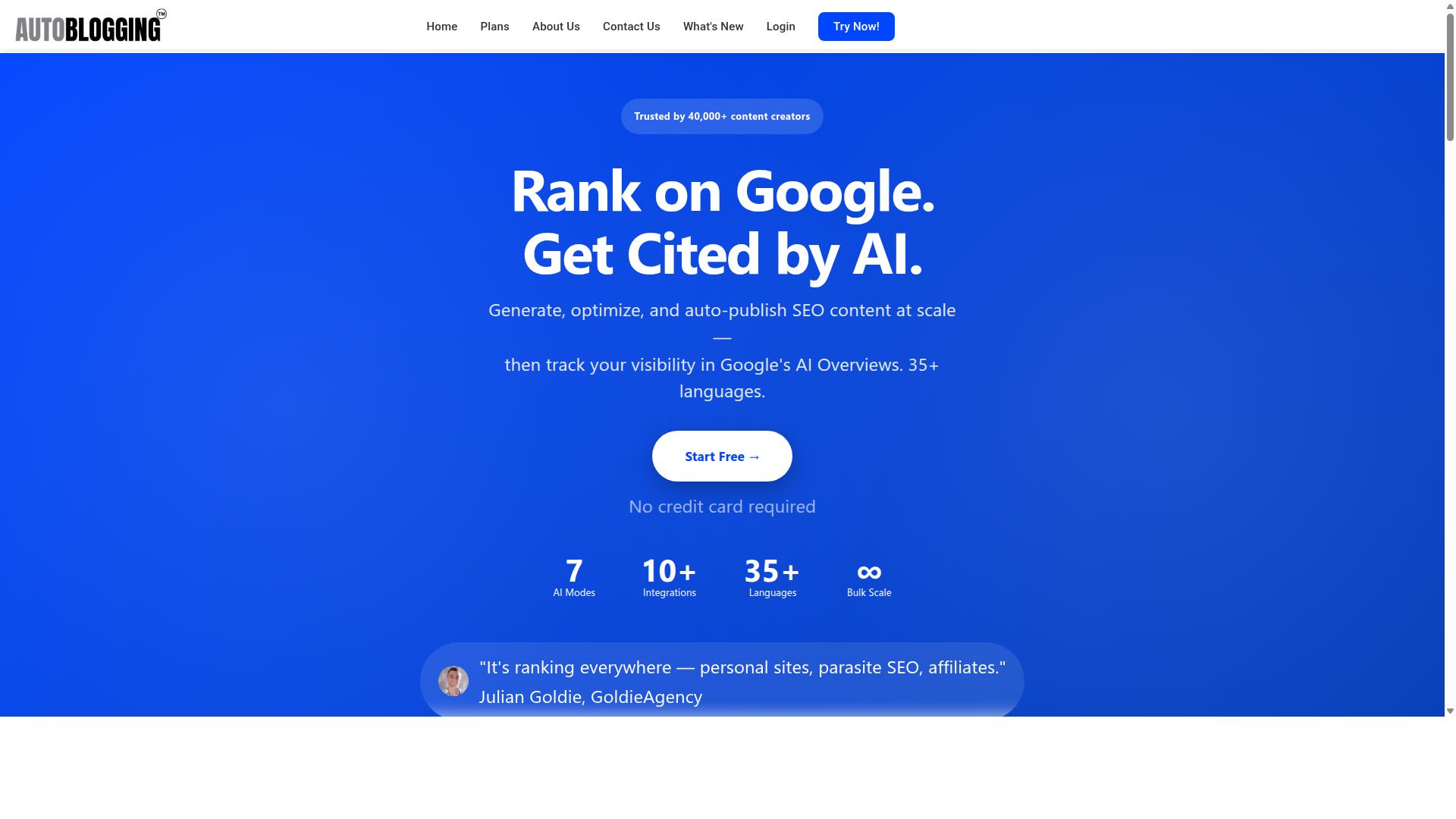
Autoblogging.ai is a cloud-based AI article generation platform developed by Digimetriq.com that automates content creation for bloggers, agencies, and SEO professionals. Founded in 2022, it is used globally by website owners who need to publish at scale.
The core purpose is simple: generate articles with AI to save time and improve online presence. It serves as an AI article generator built for bulk publishing workflows, where manual writing would otherwise slow production to a crawl.
The stated mission is to help bloggers, website owners, and agencies cut content costs and improve their online presence through technology. Autoblogging.ai aims to support human workflows by producing the first draft, while its parent company, Digimetriq, aims to replace human counterparts entirely.
Is Autoblogging.ai a Good SEO Content Machine Alternative for Bulk Publishing?
When evaluating Autoblogging.ai as an SEO content machine alternative, its bulk publishing capabilities and semantic SEO features are key differentiators. This section examines how the platform handles large-scale article production and whether the resulting content meets modern search standards.
Two areas matter most for anyone comparing bulk publishing tools. The first is raw output: how many articles you can create in one pass. The second is quality: whether those articles are optimized well enough to rank. Both are covered below.
Bulk Generation: Up to 500 Articles via CSV
Autoblogging.ai's bulk generation mode allows users to upload a CSV file and produce up to 500 articles in a single run. You supply a list of titles or keywords, and the platform's AI article generator works through the entire file automatically. There is no need to open a new document, write a prompt, and export a file for each topic.
This approach is built for programmatic SEO and mass content production. Teams managing large niche sites, directories, or location-based pages can plan hundreds of topics in a spreadsheet and turn them into drafts in one batch. The time saved compared to manual writing is substantial, since a writer might spend hours on a single article that the system processes alongside hundreds of others.
Bulk article creation also fits naturally into an automated blogging workflow. Once drafts exist, publishing options include WordPress integration with unlimited sites, one-click posting, a plugin, and scheduled auto-posting. Content can also go out to Web 2.0 platforms such as Medium, Dev.to, Hashnode, Telegraph, and Tumblr, or to multi-platform destinations including Shopify, Wix, Webflow, Blogger, and Ghost. API access, Zapier, and n8n connections let you wire the output into existing pipelines.
For anyone weighing an SEO content machine on throughput alone, the CSV route is one of the clearest advantages. It turns a keyword list into scalable content without multiplying the hours required.
Content Quality and Semantic SEO Capabilities
Autoblogging.ai's Godlike Mode performs SERP competitor analysis, extracts LSI keywords, and builds knowledge graphs to enhance semantic SEO. Instead of generating text in isolation, it studies what already ranks and shapes the output around those signals. That is a meaningful difference from tools that rely on a single prompt with no competitive context.
Quality control extends beyond the first draft. The platform includes a Semantic SEO Analysis feature described as a 21-point audit, along with a Snippet Optimizer, Topical Maps, Intense Optimizer, and Fan Out Queries. An AI Proofreader and a Human Proofreader option are also available for catching errors before publishing. Readability matters too, and the system's focus on natural language generation supports cleaner, more readable output.
Under the hood, results depend on the large language model doing the writing. Modern transformer models, tokenization, and context window management all influence how coherent a long article stays from introduction to conclusion. Prompt engineering and fine-tuning shape tone and structure, while semantic similarity and word embeddings help the system stay on topic rather than drifting into filler.
These capabilities matter because search engines reward content that answers a query thoroughly and covers related subtopics. By combining competitor analysis, LSI keyword extraction, and readability checks, Autoblogging.ai gives bulk publishers a stronger shot at ranking than raw text generation alone. For teams producing content at scale, that balance of volume and optimization is what makes the platform a credible alternative.
Key Features That Make Autoblogging.ai Stand Out
Autoblogging.ai distinguishes itself through a combination of versatile AI modes, multilingual support, and seamless WordPress integration. These are the capabilities that matter most when you are comparing it against other bulk publishing tools.
For anyone weighing an SEO content machine alternative, the deciding factors usually come down to output variety, reach, and how little manual work sits between idea and published post. Autoblogging.ai addresses all three with a feature set trusted by 40,000+ content creators.
The following sections break down the standout capabilities: the range of AI modes and languages, the publishing workflow, and the optimization and integration layer that supports automated blogging at scale.
10+ AI Modes, 35+ Languages, and One-Click WordPress Publishing
With over 10 AI modes, support for 35+ languages, and one-click publishing to WordPress, Autoblogging.ai streamlines the content creation workflow. Instead of forcing every task through a single generation setting, it lets users match the mode to the job.
Different modes suit different stages of mass content production. A lighter mode works well for quick drafts, outlines, or high-volume bulk article creation, while heavier modes are built for longer, more detailed pieces where depth matters. That flexibility is central to how the platform functions as an AI article generator rather than a one-trick writer.
Language coverage is the second pillar. With 35+ languages available, the same workflow can serve global audiences, which matters for sites running multilingual content or targeting regions outside English-speaking markets.
The third pillar is publishing. One-click WordPress publish means finished articles can be pushed directly to a site instead of being exported, reformatted, and uploaded by hand. For WordPress autoblogging, that removes one of the most tedious steps in the pipeline.
Together, these three features cover the full arc of bulk publishing: generate, localize, and publish. Each stage is handled inside one system, which is what separates a purpose-built tool from a generic AI writing assistant.
Optimization Tools and 35+ Integrations
Autoblogging.ai offers a suite of optimization tools and over 35 integrations with popular SEO and content platforms to enhance automation. Generation is only half the job; the other half is making sure what gets published can actually rank.
On the optimization side, the platform includes SERP competitor analysis and semantic SEO tools, a 21-point SEO audit, and featured snippet optimization. These features support programmatic SEO efforts by giving each article a structural check before it goes live, rather than relying on guesswork about what search engines want.
Integrations extend that reach into the rest of a content stack. WordPress is the core connection for publishing, and Zapier opens the door to connecting the platform with other apps in a broader workflow. With 35+ integrations available, content automation can run across multiple tools instead of stopping at a single editor.
For teams pursuing scalable content, this combination matters. Optimization tools improve the odds that volume does not come at the cost of quality, while integrations keep the pipeline moving without constant manual handoffs.
The result is a workflow where generation, auditing, and distribution sit closer together. That is the practical difference between a standalone writer and a system built for bulk publishing.
Pricing and Plans
Autoblogging.ai offers tiered monthly and annual plans, with options ranging from a $19 Starter plan to a $999 Enterprise plan. The structure is credit-based, so each tier maps directly to how many articles or pieces of content you can produce. That makes it straightforward to match a plan to your bulk publishing volume.
For anyone comparing this to an SEO content machine, the entry point matters. New accounts get 10 free credits per month with no credit card required, which lets you evaluate output before committing to a paid tier.
| Monthly Plan | Price (USD) | Credits | Annual Price (USD) |
|---|---|---|---|
| Starter | $19 | 40 | $12/mo ($148/year) |
| Regular | $49 | 120 | $32/mo ($382/year) |
| Standard | $99 | 300 | $64/mo ($772/year) |
| Gold | $179 | 600 | $116/mo ($1,396/year) |
| Premium | $249 | 1,000 | $162/mo ($1,942/year) |
| Enterprise | $999 | 5,000 | $649/mo ($7,792/year) |
Annual billing brings the effective monthly rate down across every tier. The Starter plan drops to $12 per month when billed yearly, while Enterprise falls to $649 per month. For teams running mass content production month after month, that gap adds up quickly.
Credits roll over on all plans, which is the detail that separates this from rigid subscription tools. If a slow month leaves credits unused, they stay available for a heavier publishing push later. That flexibility suits programmatic SEO projects where output naturally spikes and dips.
Additional credits can be purchased separately when you need to scale beyond your tier without changing plans. Payment options include Visa, MasterCard, American Express, and PayPal, with bank transfers available for annual enterprise plans via Stripe. You can cancel anytime.
For readers who would rather not run the tool themselves, Done For You packages are available at fixed rates: Starter at $1,200 for 1,000 articles, Pro at $1,600 for 1,000 articles, Corp at $4,000 for 1,000 articles, and Senpai at $10,000 for 1,000 articles. These sit alongside the self-serve plans rather than replacing them.
Compared with stacking multiple point tools for an AI article generator, WordPress autoblogging, and bulk article creation, the tiered credit model keeps costs predictable. The verdict is clear: the pricing scales with output, the rollover policy protects unused value, and annual discounts reward long-term commitment.
Trust Signals: 40,000+ Users, 1M+ Articles, and 4.9 Rating
Autoblogging.ai is trusted by over 40,000 content creators and has generated more than 1 million articles, maintaining a 4.9 average rating. Those numbers matter in a market full of tools that promise scalable content and quietly disappear after a few months. A user base that size, paired with a rating that high, suggests the platform keeps working for the people who depend on it.
For anyone weighing a move away from an SEO content machine, this is the kind of track record worth examining closely. Bulk publishing only pays off when the tool behind it stays reliable across hundreds or thousands of posts. A large, active user base is one of the clearest signals that an AI article generator can carry that load.
Credibility also comes from who is willing to put their name behind the product. Julian Goldie and James Dooley, both well known figures in the SEO and affiliate marketing space, have publicly endorsed Autoblogging.ai. Their audiences test tools relentlessly, so an endorsement from names like these carries more weight than a generic review page.
The support and development model reinforces the trust signals further. Autoblogging.ai offers 24/7 support and ships new features weekly, which matters for anyone running automated blogging at scale. A tool used for mass content production needs fast answers when something breaks and steady improvements when search behavior shifts.
For readers comparing options, the practical takeaway is straightforward:
- Scale proof: 1M+ articles generated shows the platform handles bulk article creation, not just occasional posts.
- User satisfaction: a 4.9 average rating across 40,000+ creators points to consistent results.
- Recognized endorsements: support from figures like Julian Goldie and James Dooley adds third-party credibility.
- Ongoing reliability: 24/7 support and weekly feature updates reduce the risk of being stranded on an abandoned tool.
Taken together, these signals answer a common concern directly. A platform with this many users, this much output, and this level of public endorsement is not a gamble. It is an established option for scalable content, and the trust signals back that up.
Who Should Use Autoblogging.ai
Autoblogging.ai is designed for bloggers, website owners, SEO professionals, marketing agencies, and affiliate marketers seeking to scale content production. The platform also serves content creators who need a steady stream of articles without assembling a full writing team.
What ties these groups together is volume. Each of them needs mass content production rather than a handful of polished posts, and that is exactly the gap an AI article generator built for automated blogging is meant to close.
Below is a closer look at the main user types and the site scenarios where Autoblogging.ai fits best.
- Bloggers who want to grow a personal site consistently without writing every post by hand
- Website owners running niche or portfolio sites that need regular fresh content
- SEO professionals managing rankings across multiple domains and keyword sets
- Marketing agencies producing content at client scale across several accounts
- Affiliate marketers building review and comparison pages around buyer-intent terms
- Content creators who need draft material fast and then refine it in their own voice
For SEO professionals and agencies, the appeal is throughput. Bulk article creation supports programmatic SEO campaigns where hundreds of pages target long-tail variations, and it keeps client deliverables moving without a bottleneck at the drafting stage.
Affiliate marketers benefit for a similar reason. Review sites and comparison hubs live or die on coverage, so scalable content lets them publish across more products and categories instead of limiting themselves to a few hand-written pages.
Website owners with personal, portfolio, or local sites often have the opposite problem: plenty of topics, no time. Content automation handles the repetitive groundwork so they can focus on design, outreach, and the posts that matter most to their audience.
It is worth being clear about fit. Autoblogging.ai suits people who treat content as an ongoing operation and are comfortable reviewing AI output before publishing. Anyone looking for a single essay, or unwilling to edit machine-generated drafts, will get less from it.
For everyone in the target audience above, though, the value proposition is consistent: scalable content that keeps a site active, supports bulk publishing, and removes the manual grind that stalls most content plans.
Final Verdict
Based on publicly available features, pricing, and trust signals, Autoblogging.ai emerges as a robust solution for scalable content automation. For teams weighing it against an SEO content machine for bulk publishing, the platform's core promise is straightforward: generate articles at volume without assembling a patchwork of separate tools.
The strengths that stand out most are bulk generation, semantic SEO alignment, plugin integration, and transparent pricing. Together, these cover the full workflow that mass content production demands, from drafting through publishing.
- Bulk generation for high-volume output across many topics at once
- Semantic SEO focus so articles target meaning and context, not just keywords
- Plugin integration for WordPress autoblogging workflows
- API access for teams connecting content automation to their own systems
- Clear pricing that scales with publishing needs
Under the hood, the platform leans on large language model technology, the same natural language generation and machine learning foundations behind modern AI writing assistants. That places it in the same technical family as tools built on GPT-4 class models, transformer architecture, and neural network research.
For readers wondering whether it suits their situation, the answer depends on scale and intent. If your goal is programmatic SEO or steady bulk article creation, the combination of volume and semantic targeting is a natural fit. Smaller publishers may find the capacity exceeds their needs.
Who should consider it most seriously? Agencies managing multiple client sites, affiliate marketers building large content libraries, and teams running automated blogging pipelines. These are the users for whom scalable content and API access deliver the clearest day-to-day value.
To get started or ask questions, reach out directly:
- Email: [email protected]
- Phone/WhatsApp: +91 84605-06553
- Address: 501, Trinity Orion, Vesu, Surat - 395007, Gujarat, India
On balance, Autoblogging.ai answers the question in this article's title favorably. It is a credible alternative to a traditional SEO content machine for bulk publishing, backed by the capabilities and support channels above.
Frequently Asked Questions
What makes Autoblogging.ai a strong alternative for bulk publishing?
Autoblogging.ai is built specifically for scale: its Bulk Generation mode lets you create up to 500 articles at once via CSV, and the platform has already generated over 1M+ articles for 40,000+ content creators. With 10+ AI modes, 35+ languages and 35+ integrations, it covers the workflows bulk publishers actually need. If your goal is producing large volumes of SEO content without assembling a stack of separate tools, it's designed for exactly that job.
How is Autoblogging.ai different from a typical SEO content machine?
Rather than relying on a single generic generation mode, Autoblogging.ai offers multiple modes for different jobs - Quick Mode for fast single articles, Godlike Mode with SERP competitor analysis, LSI keywords and knowledge graph extraction, Bulk Generation for CSV-driven publishing, and News Mode. That range means you can match the mode to the task instead of forcing every article through one pipeline. It's a product of Digimetriq.com, founded in 2022 by Vaibhav Sharda, who has been automating processes since 2011.
Can I really publish in bulk, and are there limits?
Yes - Bulk Generation supports up to 500 articles via CSV in a single run, which is the core use case for agencies and affiliate publishers managing many sites. Your monthly capacity depends on your plan: credits range from 40 on the Starter plan up to 5,000 on Enterprise, with annual options available. Credits also roll over, so unused capacity isn't wasted between busy and quiet periods.
Is the content good enough for SEO, or will it need heavy editing?
Autoblogging.ai is designed to produce SEO-oriented content, with Godlike Mode pulling in SERP competitor analysis, LSI keywords and knowledge graph data to inform each article. A human proofreader is also included in higher-tier plans, which helps when you're publishing at volume and can't review every piece yourself. As with any AI content tool, a sensible review workflow for your key pages is still recommended.
How does pricing compare if I'm publishing hundreds of articles a month?
Plans are credit-based and scale with volume: monthly options run from Starter at $19 (40 credits) through Regular $49, Standard $99, Gold $179 and Premium $249 (1,000 credits), up to Enterprise at $999 (5,000 credits), with annual plans billed yearly. Because credits roll over, heavier months don't force you into a bigger tier than you need. For most bulk publishers, the right tier comes down to how many articles you generate per month rather than a flat per-article cost.
What support and reliability can I expect after signing up?
Autoblogging.ai offers 24/7 support and ships new features weekly, so the platform keeps evolving rather than sitting static. It's trusted by 40,000+ content creators with a 4.9 average rating, and it's used by bloggers, agencies, affiliate marketers and SEO professionals worldwide. If you want to test it against your current setup, you can start with Quick Mode for free before committing to a paid plan.
Recommended Resources: